
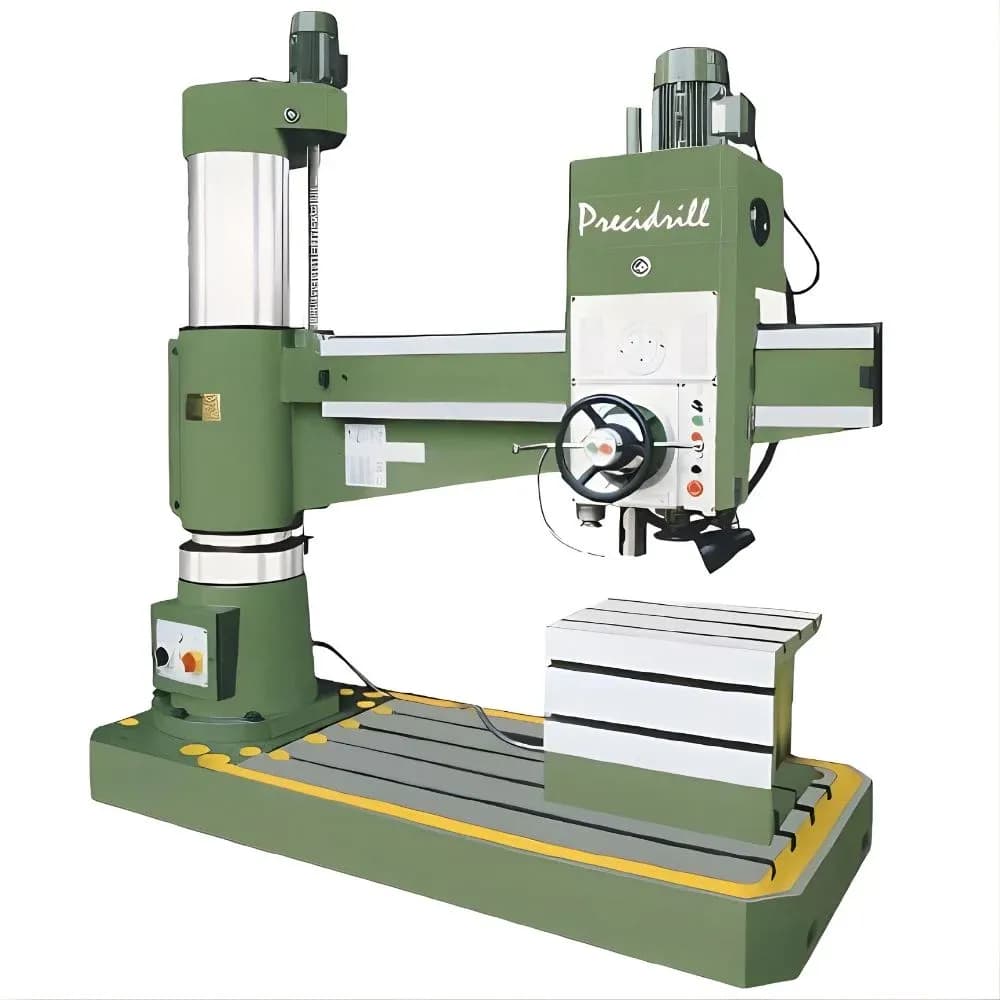
ATPL supplies the Precidrill RDH series of radial drilling machines, also known as radial drill machines: all-geared machines built for heavy industrial use, where the workpiece is too large or heavy to move and the spindle has to come to the hole instead. Three models cover the range:
- RDH3510 — 35 mm drilling capacity, 180 mm column, Morse taper 4 spindle, spindle speeds from 108 to 1,000 rpm and a 1.5 to 2.2 kW main motor
- RDH4011 — 40 mm drilling capacity, 230 mm column, Morse taper 4 spindle, spindle speeds from 40 to 1,250 rpm and a 2.2 kW main motor
- RDH5016 — 50 mm drilling capacity, 280 mm column, Morse taper 5 spindle, spindle speeds from 78 to 1,100 rpm and a 4 kW main motor
All three models have a 360-degree rotating radial arm and 6 spindle speed steps. Feed ranges from 0.16 to 0.25 mm per revolution on the RDH3510 and RDH4011, and from 0.10 to 0.56 mm per revolution on the RDH5016. The drill head travels 500 mm, 680 mm and 1,160 mm along the arm, and a power-elevated arm raises and lowers at 1.32 m per minute. Machine weight is 800 kg, 1,600 kg and 2,800 kg.
Every radial drilling machine has precision ground arm ways, hardened and ground head stock gears, and a heavy ribbed cast iron base and arm, with hydraulic clamping and ergonomic, operator-friendly controls on the head. A box table, coolant equipment, a tool box and a machine manual are supplied as standard. A reducing sleeve and a tilting worktable are available as options; the tilting worktable measures 500 x 500 mm, has 22 mm T-slots and tilts from 0 to 90 degrees.
Main Parts of a Radial Drilling Machine
- Column — the upright structure, 180 to 280 mm in diameter, that the radial arm rotates around and moves up and down on
- Radial Arm — swings 360 degrees around the column and carries the drill head along its ground ways
- Head Stock — houses the hardened and ground gears that set the spindle speed and feed rate
- Spindle — a Morse taper 4 or 5 spindle that holds the drill and drives it into the workpiece
- Base and Box Table — the heavy ribbed cast iron base and the box table that hold the workpiece or fixture
- Hydraulic Clamping — holds the arm and head firmly in position once the spindle is over the hole
- Power Arm Elevation — a dedicated motor of 0.75 or 1.5 kW that raises and lowers the arm to suit the height of the workpiece