
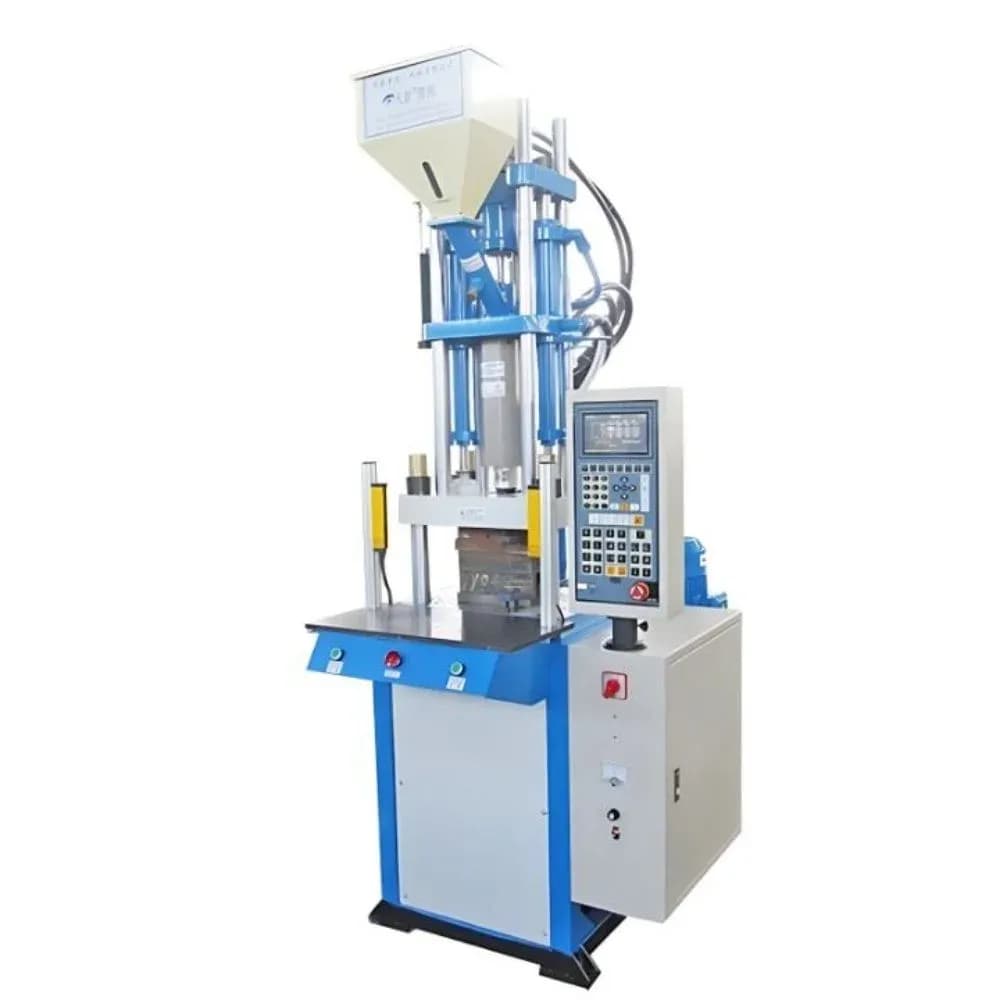
A vertical injection moulding machine works like a traditional horizontal machine, but it is built to operate on the vertical axis. The mould opens up and down, and the machine stands tall instead of lying along the floor. ATPL offers the Precimould MPT Series in a nine-model lineup:
- MPT-150, MPT-300 and MPT-450 — 15, 30 and 45 ton clamping force, for small parts, with theoretical injection weight up to 109 g
- MPT-550 and MPT-850 — 55 and 85 ton clamping force, with theoretical injection volume up to 254 cm³
- MPT-1200, MPT-1500, MPT-2000 and MPT-2500 — 120, 150, 200 and 250 ton clamping force, with screw diameters up to 70 mm and theoretical injection weight up to 900 g
Across the series, platen size runs from 390 x 250 mm to 1,330 x 1,060 mm, tie-bar spacing from 275 x 135 mm to 910 x 640 mm, and hopper capacity from 15 to 30 litres. Most models offer three screw options, so you can match the screw to your material and shot weight. The machine is available in hydraulic, electric and hybrid executions to meet a range of customer requirements.
See the model comparison table on the product page for injection rate, screw stroke, mould height, motor power and machine dimensions for every model.
Main Parts of a Vertical Injection Moulding Machine
- Injection Unit — screw and barrel that melt the plastic and inject it into the mould
- Clamping Unit — platens and tie bars that hold the mould shut; clamping force from 15 to 250 ton
- Hydraulic System and Pump Motor — from 4 kW on the MPT-150 to 30 kW on the MPT-2500
- Heating System — heater power from 2 kW to 18.5 kW depending on the model
- Hopper — 15 to 30 litre capacity
- Ejector — ejector force from 1.7 to 4 ton, with stroke from 55 to 135 mm
- Control Panel — sets and monitors the moulding cycle